ADHD and Object Permanence: Why Out of Sight Means Gone

Contents·14
ADHD doesn't impair object permanence. That's a milestone toddlers finish by about age two, and the clinicians who write about it agree ADHD leaves it intact. What people mean by the phrase is real though: working memory drops the location of things, so a closed box stops registering as a box with contents. The label is borrowed. The problem underneath it isn't.
This post does two jobs. First the short version of what the term means and why it stuck to ADHD anyway. Then the part almost nobody writes about, which is what to do about the belongings you can't see, as opposed to the five things you carry around every day.
What object permanence means
Object permanence is a developmental milestone from Piaget: the understanding that things keep existing when you can't see, hear or touch them. Babies work it out gradually, with full mastery around 18 to 24 months. A six-month-old who watches you hide a rattle under a blanket may act as though the rattle stopped existing. A three-year-old knows better, and so does every adult reading this.
That's why clinicians push back on the ADHD version of the claim. Medical News Today, reviewed by psychiatrist Nicole Washington, states plainly that "object permanence is not a recognized problem or condition in adults with ADHD". Talkiatry, reviewed by psychiatrist Michael Roman, puts it the same way: "object permanence" is not a condition or a symptom of one.
San Francisco psychiatrist John Kruse offers the replacement most people are reaching for. According to him, "out of sight, out of mind" is a more accurate phrase, and he coined a separate one for the more common version, where the thing is right in front of you and still doesn't register: "in sight, but no insight."
You know the winter coats exist. You just can't tell me which box they're in.
Why ADHD gets blamed for poor object permanence
The mechanism people are describing is working memory, one of the executive functions ADHD hits hardest. Putting something away is a small memory event, and an ADHD brain that's already three thoughts ahead often never records it.
The research here is solid, unlike the object-permanence framing. A meta-analytic review by Kasper, Alderson and Hudec found "large between-group effect sizes across both working memory domains," concluding that children with ADHD show "statistically significant, large magnitude working memory deficits relative to their typically developing peers." An earlier meta-analysis by Martinussen and colleagues found the same pattern, strongest on the spatial side. Both studied children, so treat them as evidence about the mechanism rather than a measurement of adults.
Losing things is also on the symptom list itself. NIMH names "frequently losing things or being forgetful in activities" among the inattention symptoms of ADHD, alongside trouble remembering daily tasks. And this applies to a lot of people: CDC researchers reported that in 2023, an estimated 15.5 million US adults, or 6.0%, had a current ADHD diagnosis, about half of them diagnosed as adults.
Two clinicians in the same Healthline piece land on the useful reframe. Stephanie Lewis, LSW: this "can sometimes look like a lack of object permanence, but it's more about the challenges of staying focused and remembering things." April Crowe, LCSW, calls it a "working memory deficit or task management difficulty" rather than anything to do with permanence.
If the day-to-day version is your problem, keys and phone and headphones, I wrote the tactics for that in ADHD and losing things. This post is about everything else you own. The overlap with a home inventory app starts further down, and I'll be specific about where it helps and where it doesn't.
Object permanence and ADHD, side by side
The top-ranking articles all explain this in prose, where it keeps getting buried. Here it is as a table.
| Object permanence (Piaget) | What ADHD does instead | |
|---|---|---|
| What it is | Knowing unseen things still exist | Failing to keep an unseen thing in active memory |
| When it develops | Complete by roughly age 2 | Working memory keeps developing into adulthood |
| Is it impaired in ADHD? | No, per every clinician quoted above | Yes, with large measured effect sizes |
| What it feels like | Nothing, you have it | The bin is there, its contents are not |
| Where it shows up | Infant psychology experiments | Closed drawers, garages, storage units |
Object permanence is intact in ADHD. What fails is holding an unseen thing in working memory. The distinction matters for one practical reason. If the problem were one of existence, no system would help you, because you'd have to relearn that objects persist. Retrieval is a different kind of problem. A system can answer "where" on your behalf, so your memory never has to be the thing that knows.
The advice everyone gives covers five objects
Read the top-ranking articles on this and you'll notice they converge on the same tips: visual cues, recurring phone reminders, a designated spot for your keys, clear bins instead of opaque ones, narrate where you put things. That advice is genuinely good. I've recommended most of it myself in ADHD home organization hacks and the accompanying tools list.
It also stops at about five objects. Keys, wallet, phone, glasses, medication. The everyday carry.
Now count what you own. Not the five things on the hook by the door: the ski boots, the cables in the drawer of cables, the second set of bed linen, the Christmas lights, the drill you might have lent to your brother, the box marked nothing in the basement. For most households that's hundreds of items, nearly all of them behind a door or a lid, and none of them addressable by a reminder that fires at 6pm.
This is the gap. Out of sight means gone applies far more to the stuff you store than to the stuff you carry, and the storage half gets almost no attention.
The rooms you own but can't picture
Try this: without getting up, name what's in the third box in your storage space. Most people can't, ADHD or not. The difference is what it costs you.
A reader put the trap precisely in a question to ADDitude's organizing columnist Susan C. Pinsky: a 42-year-old with ADHD who forgets about anything placed in a drawer or closet, and so keeps things out in plain view, which cancels out the decluttering. That's the bind. Tidy means hidden, and hidden means gone, so tidying costs you access to your own belongings.
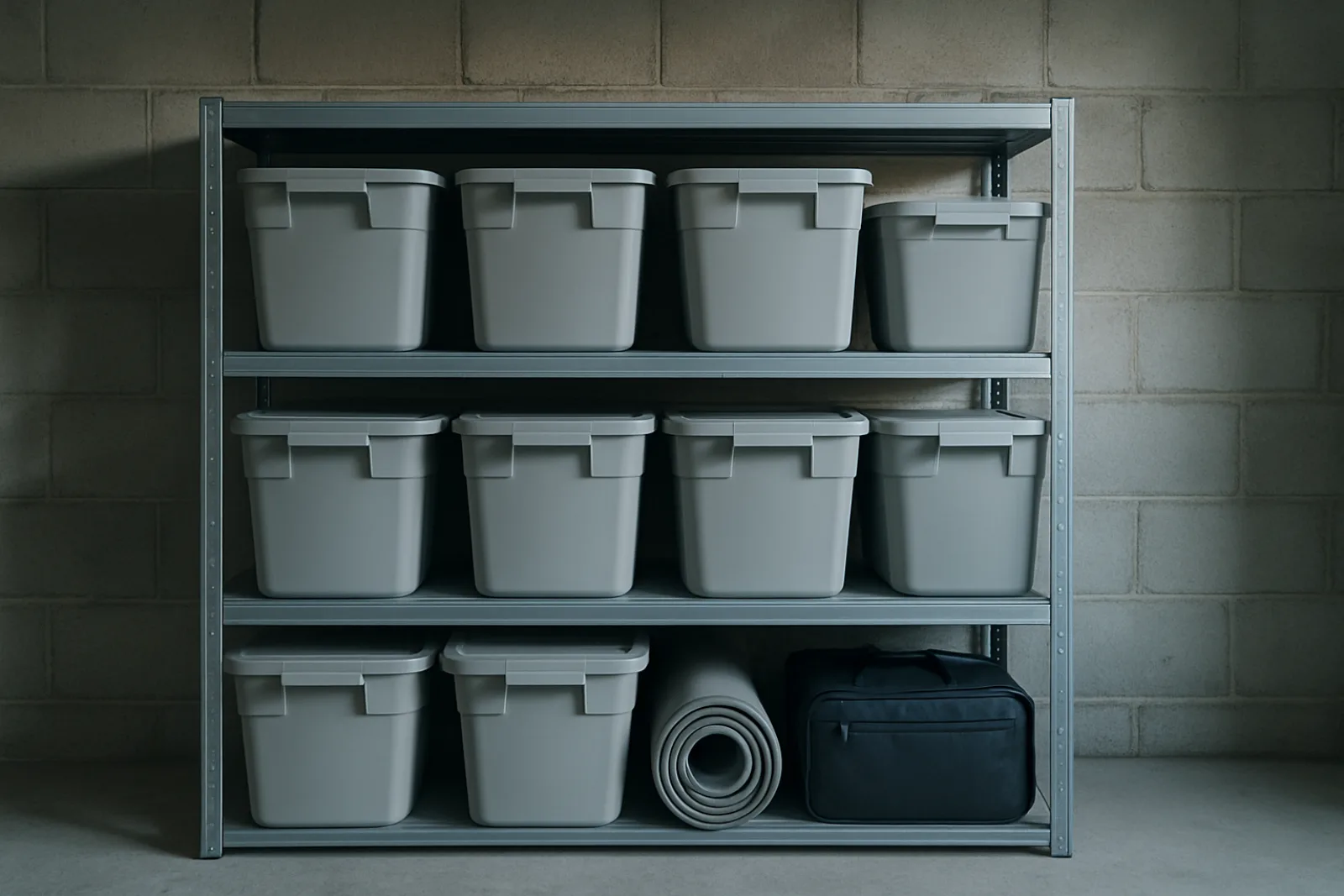
Ten boxes, no labels, no idea. Storage that is tidy and unsearchable at the same time
The failure modes are specific:
- You buy the second one. This one comes up constantly in ADHD spaces, in near-identical words, on Quora and in coaching writing about the working-memory link. The cheap version is another phone charger. The expensive version is a power tool you already own, in a box two meters away.
- You keep paying to store things you've forgotten. A storage unit is a monthly fee for objects you can no longer list.
- The thing you need is technically findable, so you don't ask. You spend forty minutes excavating instead of thirty seconds looking something up.
- Insurance gets rough. If you can't list what you own, you can't claim for it. That's the same skill applied to a worse day, which is why documenting valuables and serial numbers is worth doing before you need it.
Habits are exactly what working memory struggles to sustain, so a new one won't stick. What works is a one-time pass that turns your home into something you can query, plus a small rule for keeping it current.
Start with the free home inventory checklist if you want a paper version, room by room, nothing to sign up for. Do one room, not the house. One finished room still answers "where's the drill" the next time you need it, and shrinking the task is often the difference between doing it and not.
Why buying two of everything is the expensive fix
One popular workaround deserves a closer look, because it's advice with a bill attached. LifeSkills Advocate's guide to object permanence workarounds recommends you "keep multiples of the essentials", naming chargers, water bottles and scissors.
For a three-euro item, that's fine. Buy the second charger. Nobody should build a tracking system for phone cables.
The advice breaks on anything that isn't cheap, and it breaks quietly. Duplicates take up storage, which makes the storage harder to see into, which produces more duplicates. I couldn't find a single study measuring how much people with ADHD spend on things they already own. The stats that circulate on this, the "average person wastes a thousand a year", trace back to nothing you can check, so I'm not going to quote them at you. What I can say is that the redundancy strategy has a ceiling, and the ceiling arrives at roughly the price of a drill.
Making the memory external
Itemlist, the home inventory app I work on, exists for this failure mode. It does nothing for your keys, and I won't pretend otherwise. It earns its place at the scale where labels stop working, which is the shelf of ten boxes further up this page.
The structure follows the storage rather than a shopping list. Locations, then rooms, then containers, and containers nest inside other containers, which is how bulk storage stacks up in practice, a box inside a wardrobe inside a spare room. So "the third box in the storage space" turns into an address you can look up. Multiple locations are uncapped even on the free plan, so a flat, a parents' attic and a storage unit sit in one inventory.
The part that answers the duplicate problem is search, and it works offline, which is the condition you're in when you're standing in a basement with no signal. Ten seconds of checking is what removes the reason to buy the second drill. The rest of the mechanics, photographing things and giving them one home, are the same ones I covered in ADHD and losing things, so I won't run through them twice.
Itemlist is free to start, capped at 100 items and 20 containers, which is enough to do one room and find out whether the habit sticks before paying for anything. If you'd rather compare options first, my roundup of ADHD apps for iPhone covers the other categories too, and it's the most-read thing on this site, which tells me the audience for this problem is much larger than the audience for home inventory software.
FAQ
Does ADHD affect object permanence?
No. Object permanence is an infant developmental milestone that people with ADHD complete normally. The experience behind the phrase comes from working memory and attention difficulties, which is why psychiatrists correct the term while agreeing the underlying problem is real.
Why do I forget something exists the moment it's out of sight?
Storing something is a brief memory event that ADHD often fails to encode, so the location was never saved rather than forgotten. A closed container then offers your brain no cue at all. Transparent bins or a searchable catalog give it one.
Why do I keep buying things I already own?
Because a duplicate purchase only needs one failed lookup. If you can't confirm you own the item, buying it is the fast way to stop wondering. Being able to check what you own in a few seconds removes the reason to re-buy.
Does this affect relationships too?
People describe the same pattern with friends they don't see, and it comes up often in ADHD forums. Talk to a therapist about that one. No organizing system fixes a relationship, and this post can't help you there.
Is this the same as hoarding?
No, though they can overlap. ADHD storage difficulty is usually about retrieval and follow-through, while hoarding disorder is a distinct diagnosis involving distress at discarding. If clutter is genuinely distressing or unsafe, that's worth raising with a clinician rather than an organizing system.
The part that surprised me
No statistic makes the strongest case here. "Object permanence" spread through ADHD communities despite being the wrong word, and it spread because it described something people recognized instantly and had no better name for.
That's usually a sign a problem is under-served rather than imaginary. The advice caught up for the five things by the door. For the several hundred behind doors, it mostly hasn't. Pick one room this week and find out what's in it.

![How to Organize Your Home with ADHD [5 ADHD Adult Organization Tools]](/_next/image/?url=%2Fstatic%2Fimages%2Fblog%2Fadhd-home-organization-tools%2FBlog-ADHD-Adult-Organization-Tools-1.jpg&w=3840&q=75&dpl=dpl_2bKLoZTmjmywN3Tg7ZRjPDoYMx2p)
